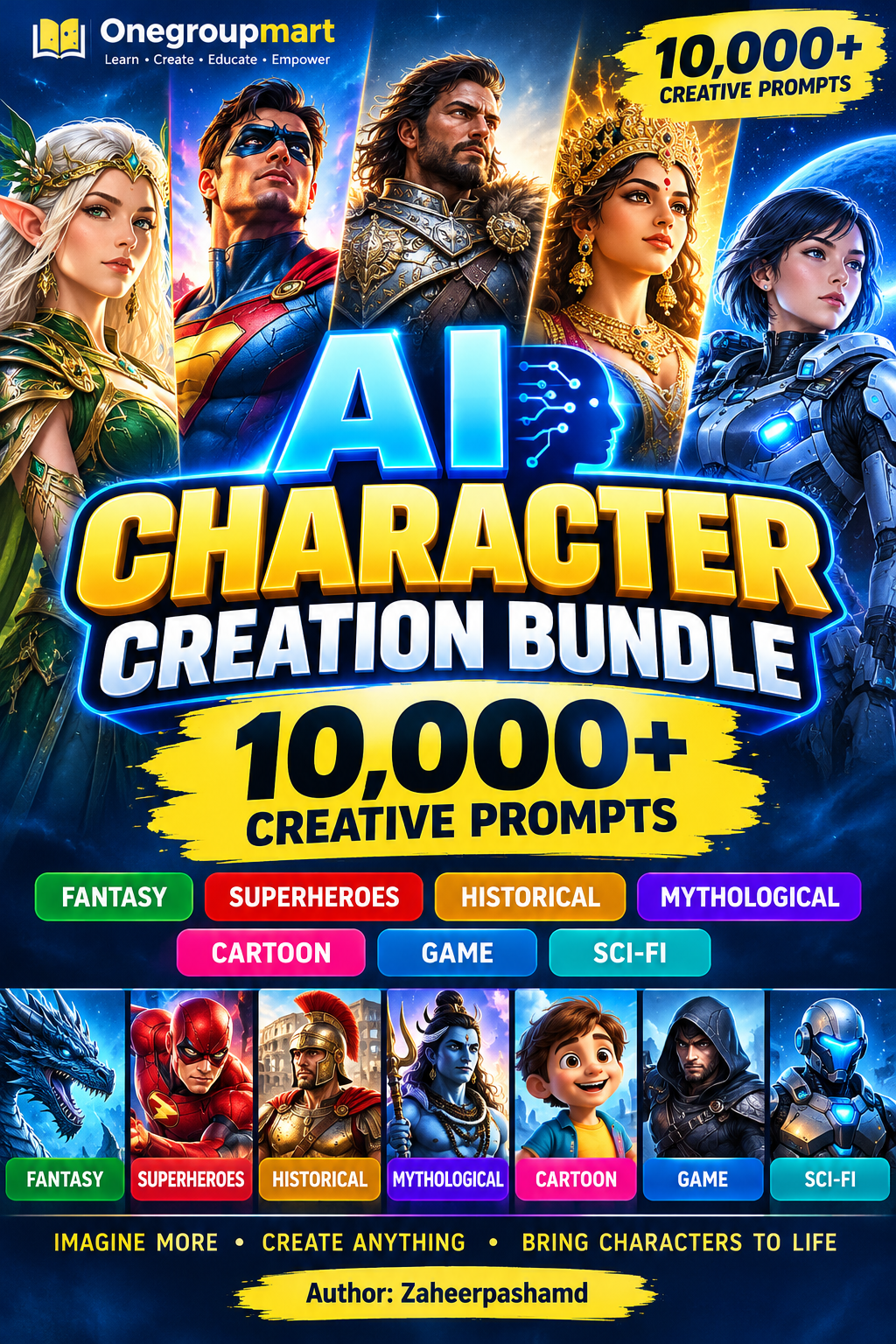
AI Character Creation Bundle – 10,000 Creative AI Prompts for Fantasy, Superheroes, Mythology, Sci-Fi & More
Original price was: ₹899.00.₹299.00Current price is: ₹299.00.
AI Character Creation Bundle – 10,000+ Creative Prompts
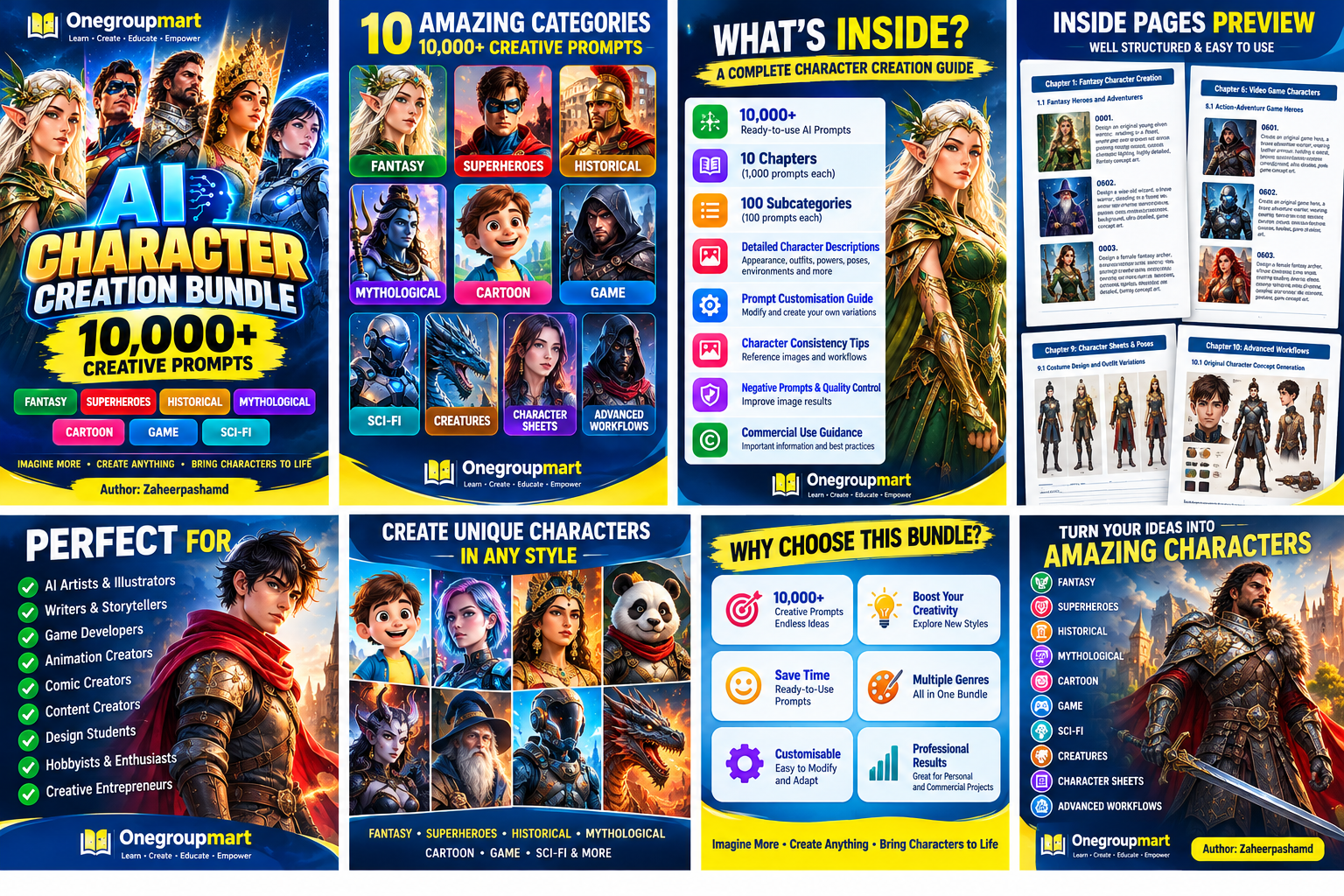
Unleash your imagination with the AI Character Creation Bundle, featuring 10,000 creative prompts for designing unique fantasy heroes, superheroes, mythological beings, historical characters, cartoon personalities, game characters, sci-fi figures, and more. Perfect for AI artists, digital creators, writers, game developers, and designers, this bundle helps you generate original character concepts, explore different styles, and bring your creative visions to life. Ideal for character design, storytelling, concept art, and digital content creation.
Description
MASTER E BOOK CREATION PROMPT
AI Character Creation Bundle – 10,000 Creative AI Prompts for Fantasy, Superheroes, Mythology, Sci-Fi & More
Act as an expert eBook author, AI prompt engineer, character designer, fantasy world-builder, game concept artist, animation creative director, and digital product publisher.
Create a comprehensive, professionally structured eBook titled:
“AI Character Creation Bundle: 10,000 Ultimate AI Prompts for Fantasy Characters, Superheroes, Historical Figures, Mythological Beings, Cartoon Characters, Game Characters & Sci-Fi Worlds.”
Brand: Onegroupmart
Author/Publisher: Zaheerpashamd
Tagline: Imagine More. Create Anything. Bring Characters to Life.
The eBook must be suitable for sale as a premium digital product for artists, illustrators, writers, game developers, animation creators, comic creators, AI image-generation users, designers, content creators, and hobbyists.
The primary objective is to provide 10,000 distinct, detailed, useful, and ready-to-copy AI character creation prompts, organised into 10 chapters containing exactly 1,000 prompts each.
Do not provide only an outline, sample prompts, or a short guide. Generate the complete eBook with all 10,000 prompts, a professional introduction, detailed instructions, prompt-customisation templates, commercial-use guidance, and a conclusion.
1. EBOOK STRUCTURE
Create the following sections in order:
- Professional front cover.
- Copyright and publishing information.
- Disclaimer and AI-generated content notice.
- Welcome to the AI Character Creation Bundle.
- Introduction to AI character design.
- How to use the 10,000 prompts.
- AI character creation workflow.
- Guide to writing effective character prompts.
- Prompt customisation system.
- Ten comprehensive prompt chapters.
- Character consistency and reference-image workflows.
- Character sheets, poses, expressions, outfits, and turnarounds.
- Character storytelling and world-building guide.
- Genre-specific character design tips.
- Negative prompts and quality-control guidance.
- Image-generation workflow examples.
- Commercial-use and intellectual-property considerations.
- Final creative checklist.
- Conclusion.
- About the Author and Onegroupmart.
Use clear headings, subheadings, numbered prompts, examples, tables where useful, and consistent formatting throughout the eBook.
2. THE 10 CHAPTERS – 10,000 PROMPTS
Each chapter must contain exactly 1,000 numbered prompts. Each chapter should have 10 subcategories, with 100 prompts per subcategory.
Chapter 1: Fantasy Character Creation – 1,000 Prompts
Create prompts covering:
- Fantasy heroes and adventurers – 100 prompts.
- Wizards, witches, and spellcasters – 100 prompts.
- Elves, dwarves, and magical humanoids – 100 prompts.
- Dragons, magical beasts, and mythical creatures – 100 prompts.
- Dark fantasy and cursed characters – 100 prompts.
- Fantasy royalty, kings, queens, and nobles – 100 prompts.
- Warriors, knights, archers, and guardians – 100 prompts.
- Fairy folk, nature spirits, and enchanted beings – 100 prompts.
- Fantasy villains, necromancers, and dark lords – 100 prompts.
- Original fantasy character concepts and hybrid species – 100 prompts.
Include detailed visual descriptions, clothing, armour, magical abilities, weapons, accessories, poses, environments, colour palettes, and distinctive personality traits.
Chapter 2: Superhero and Supervillain Creation – 1,000 Prompts
Create prompts covering:
- Original male superheroes – 100 prompts.
- Original female superheroes – 100 prompts.
- Team-based heroes and superhero squads – 100 prompts.
- Supervillains and masterminds – 100 prompts.
- Cosmic heroes and intergalactic protectors – 100 prompts.
- Technology-powered heroes and robotic champions – 100 prompts.
- Elemental heroes using fire, water, earth, wind, and lightning – 100 prompts.
- Mutants, shapeshifters, and transformation-based characters – 100 prompts.
- Secret identities, civilian looks, and alternate costumes – 100 prompts.
- Original superhero universes, signature powers, and character concepts – 100 prompts.
Use original character names, costumes, emblems, powers, origin concepts, silhouettes, equipment, and fictional worlds. Avoid copying protected characters, famous costumes, signature logos, or distinctive franchise designs.
Chapter 3: Historical Character Creation – 1,000 Prompts
Create prompts covering:
- Ancient civilizations and historical leaders – 100 prompts.
- Medieval kings, queens, knights, and nobles – 100 prompts.
- Historical warriors, soldiers, and military commanders – 100 prompts.
- Explorers, navigators, and adventurers – 100 prompts.
- Scientists, inventors, and scholars – 100 prompts.
- Artists, writers, musicians, and cultural figures – 100 prompts.
- Everyday people from historical periods – 100 prompts.
- Historical traders, craftspeople, and workers – 100 prompts.
- Period costumes, ceremonial clothing, and traditional attire – 100 prompts.
- Historically inspired fictional characters from different regions and eras – 100 prompts.
Specify the historical period, geographical setting, authentic clothing, fabrics, accessories, hairstyles, tools, architecture, social context, and appropriate visual details.
When depicting real historical people, aim for respectful and contextually accurate representations. Clearly distinguish documented historical information from fictional interpretation.
Chapter 4: Mythological Character Creation – 1,000 Prompts
Create prompts covering:
- Greek and Roman mythology-inspired characters – 100 prompts.
- Norse mythology-inspired gods, giants, and heroes – 100 prompts.
- Egyptian mythology-inspired deities and guardians – 100 prompts.
- Indian mythology-inspired divine, heroic, and legendary figures – 100 prompts.
- Japanese mythology-inspired spirits and supernatural beings – 100 prompts.
- Chinese mythology-inspired immortals, dragons, and legendary figures – 100 prompts.
- Celtic and other European folklore-inspired characters – 100 prompts.
- African mythology and folklore-inspired characters – 100 prompts.
- Indigenous and other global folklore-inspired beings, handled respectfully – 100 prompts.
- Original mythological creatures, divine beings, and legendary hybrids – 100 prompts.
Use culturally sensitive visual research, distinctive symbolic objects, traditional clothing, meaningful environments, and clear differentiation between traditional accounts and original inventions.
Do not misrepresent sacred traditions or present invented details as authentic cultural facts.
Chapter 5: Cartoon and Animation Character Creation – 1,000 Prompts
Create prompts covering:
- Cute cartoon characters – 100 prompts.
- Funny characters and exaggerated comedy designs – 100 prompts.
- Family-friendly animated characters – 100 prompts.
- Cartoon animals and anthropomorphic characters – 100 prompts.
- Educational characters for children – 100 prompts.
- Fantasy cartoon characters – 100 prompts.
- Cartoon robots and futuristic mascots – 100 prompts.
- Villains, sidekicks, and supporting characters – 100 prompts.
- Expressive faces, emotions, and character poses – 100 prompts.
- Original animation styles, character ensembles, and mascot concepts – 100 prompts.
Specify the intended audience, body proportions, facial design, expression, silhouette, colour palette, rendering approach, pose, background, and personality.
Use original designs rather than imitating the signature appearance of existing animation studios or copyrighted characters.
Chapter 6: Video Game Character Creation – 1,000 Prompts
Create prompts covering:
- Action-adventure game heroes – 100 prompts.
- RPG heroes, classes, and character builds – 100 prompts.
- Warriors, assassins, archers, and combat specialists – 100 prompts.
- Game bosses and powerful enemies – 100 prompts.
- Sci-fi game protagonists and space explorers – 100 prompts.
- Survival-game characters and post-apocalyptic survivors – 100 prompts.
- Multiplayer avatars and customisable player characters – 100 prompts.
- NPCs, merchants, companions, and quest-givers – 100 prompts.
- Creature designs, mounts, pets, and collectible companions – 100 prompts.
- Original game factions, character rosters, and legendary champions – 100 prompts.
Include character role, visual silhouette, equipment, rarity, abilities, faction, environment, gameplay function, and visual readability at different screen sizes.
Where appropriate, request front, side, and back views, equipment variations, animation-ready poses, and concept-art presentation.
Chapter 7: Science Fiction and Futuristic Characters – 1,000 Prompts
Create prompts covering:
- Space explorers and astronauts – 100 prompts.
- Alien species and extraterrestrial beings – 100 prompts.
- Androids, cyborgs, and artificial intelligence characters – 100 prompts.
- Futuristic soldiers and planetary defenders – 100 prompts.
- Cyberpunk citizens, hackers, and rebels – 100 prompts.
- Space emperors, interstellar diplomats, and alien royalty – 100 prompts.
- Mutated survivors and post-apocalyptic wanderers – 100 prompts.
- Biomechanical and synthetic lifeforms – 100 prompts.
- Time travellers, dimension explorers, and multiverse characters – 100 prompts.
- Original futuristic civilizations, species, and character concepts – 100 prompts.
Describe technology, materials, anatomy, interfaces, cybernetic enhancements, environmental conditions, cultural details, and futuristic costume design.
Maintain internal consistency between a character’s species, technology, role, and world.
Chapter 8: Creature, Monster, and Hybrid Character Creation – 1,000 Prompts
Create prompts covering:
- Dragons and winged creatures – 100 prompts.
- Sea monsters and aquatic beings – 100 prompts.
- Forest creatures and elemental beasts – 100 prompts.
- Giants, titans, and colossal beings – 100 prompts.
- Undead creatures and supernatural monsters – 100 prompts.
- Cute fantasy pets and magical companions – 100 prompts.
- Insect-inspired and arthropod-inspired beings – 100 prompts.
- Animal hybrids and imaginative species – 100 prompts.
- Biomechanical monsters and experimental creatures – 100 prompts.
- Original creature species, anatomy studies, and creature concept sheets – 100 prompts.
Include anatomy, size, texture, movement, habitat, temperament, defensive adaptations, colour patterns, and distinctive identifying features.
Prioritise imaginative original designs and avoid making all creatures variations of the same template.
Chapter 9: Character Outfits, Expressions, Poses, and Character Sheets – 1,000 Prompts
Create prompts covering:
- Costume design and outfit variations – 100 prompts.
- Armour, weapons, and accessories – 100 prompts.
- Facial expressions and emotional studies – 100 prompts.
- Dynamic action poses and movement – 100 prompts.
- Front, side, and back character turnarounds – 100 prompts.
- Character model sheets and visual reference sheets – 100 prompts.
- Colour palettes, material studies, and lighting variations – 100 prompts.
- Age variations, alternate forms, and transformations – 100 prompts.
- Team lineups, character relationships, and group compositions – 100 prompts.
- Professional character concept-art presentations and design portfolios – 100 prompts.
Focus on visual consistency, readable silhouettes, repeatable design details, clear labels when supported, and practical production references.
Chapter 10: Advanced AI Character Design and Creative Workflows – 1,000 Prompts
Create prompts covering:
- Original character concept generation – 100 prompts.
- Detailed character biography and personality design – 100 prompts.
- Character backstories, motivations, and conflicts – 100 prompts.
- World-building and cultural context – 100 prompts.
- Consistent character generation across multiple images – 100 prompts.
- Reference-image and image-to-image workflows – 100 prompts.
- Character development across story stages – 100 prompts.
- Professional creative briefs for illustrators and concept artists – 100 prompts.
- Character portfolios, promotional art, and presentation materials – 100 prompts.
- Advanced prompt refinement, quality control, and production-ready character concepts – 100 prompts.
Include prompts that combine visual design with personality, story, environment, practical production needs, and consistency requirements.
3. REQUIREMENTS FOR EVERY PROMPT
Every prompt must be useful, specific, distinct, and ready to copy into a compatible AI tool.
Where appropriate, include:
- Character type and role.
- Original character name or naming instructions.
- Species, ancestry, or fictional origin.
- Age range appropriate to the intended character.
- Physical appearance and proportions.
- Facial features and hairstyle.
- Clothing, armour, and accessories.
- Powers, skills, tools, or equipment.
- Personality and emotional expression.
- Pose, camera angle, and composition.
- Lighting and colour palette.
- Background or environment.
- Art medium or visual rendering direction.
- Mood and atmosphere.
- Intended output, such as a portrait, full-body illustration, character sheet, or turnaround.
- Constraints that help avoid visual inconsistencies.
Do not force every detail into every prompt. Choose the details relevant to the requested character or output.
Use a balanced mixture of short, medium, and advanced prompts. Make the prompts varied in theme, structure, creative direction, and intended use.
Avoid duplicate prompts, simple synonym swaps, repetitive character concepts, empty placeholders, and generic instructions such as “create a cool character.”
4. PROMPT FORMAT
Use this format consistently:
Prompt 0001: [Descriptive Prompt Title]
Category: Fantasy / Superhero / Historical / Mythological / Cartoon / Game / Sci-Fi / Creature / Character Sheet / Advanced Workflow.
AI Prompt:
“Design an original [character type] with [distinctive appearance], wearing [specific clothing or equipment], featuring [signature design elements]. Give the character [personality or visual mood]. Place the character in [appropriate environment] with [lighting and colour palette]. Use [art direction or rendering style]. Show [composition or view requirements]. Maintain clear visual hierarchy, detailed materials, coherent anatomy, and a memorable silhouette. Create an original design that does not imitate a specific copyrighted character.”
Customisation Ideas: Briefly explain which variables the user can change when useful.
Keep the core prompt ready to copy. Do not make every prompt depend on additional explanations or manual editing.
5. ADVANCED PROMPT CUSTOMISATION SYSTEM
Include a separate section containing reusable prompt components for:
Character Identity
- Species or character type.
- Role and occupation.
- Personality.
- Origin and background.
- Unique traits and abilities.
Visual Appearance
- Face shape and features.
- Hair, eyes, and skin or surface texture.
- Body proportions and silhouette.
- Clothing, armour, and accessories.
- Materials and distinctive details.
Visual Style
- Realistic concept art.
- Stylised 3D character design.
- Hand-drawn illustration.
- Watercolour illustration.
- Comic-book-inspired original art.
- Anime-inspired original art.
- Pixel-art character design.
- Low-poly game art.
- Stop-motion-inspired character design.
- Flat-vector mascot illustration.
Treat these as broad artistic directions, not instructions to copy a specific living artist or protected franchise.
Composition and Presentation
- Portrait, waist-up, or full-body.
- Front, side, and back views.
- Character turnaround.
- Expression sheet.
- Action pose.
- Neutral reference pose.
- Plain background.
- Environment concept art.
- Multiple costume variations.
Lighting and Atmosphere
- Soft studio lighting.
- Dramatic rim lighting.
- Golden-hour lighting.
- Moonlit atmosphere.
- Neon lighting.
- Foggy environments.
- Magical illumination.
- High-contrast cinematic lighting.
Explain how to combine these components without producing contradictory instructions.
6. NEGATIVE PROMPTS AND QUALITY CONTROL
Include general negative-prompt examples where supported by the chosen AI image generator.
Possible unwanted results include:
- Unintended duplicate limbs.
- Distorted anatomy.
- Inconsistent costume details.
- Unclear facial features.
- Blurred focal subjects.
- Unwanted text and watermarks.
- Cluttered backgrounds.
- Inconsistent character proportions.
- Unintended duplicate characters.
Explain that negative-prompt support and effectiveness vary by tool. A negative prompt cannot guarantee perfect anatomy, consistent text, or error-free output.
Include a practical quality-control checklist for evaluating character images before using them in a project.
7. CHARACTER CONSISTENCY WORKFLOW
Explain how users can maintain a character’s appearance across multiple generations.
Include prompts and workflow guidance for:
- Creating a canonical character description.
- Establishing a reference image.
- Recording fixed appearance details.
- Creating front, side, and back views.
- Producing expression sheets.
- Designing alternate costumes without changing identity.
- Keeping colours, markings, accessories, and proportions consistent.
- Using reference-image or character-reference features where available.
- Checking each new image against the original design.
Do not promise perfect consistency across different AI tools or generations.
8. REALISTIC AND ORIGINAL HISTORICAL OR MYTHOLOGICAL DESIGNS
For historical and mythological prompts:
- Identify the intended era, culture, or tradition where relevant.
- Encourage appropriate research into clothing, architecture, symbols, and materials.
- Clearly distinguish documented history from creative interpretation.
- Treat living cultural traditions and sacred imagery respectfully.
- Avoid presenting invented costume elements as historically authentic.
- Provide original alternative concepts where accuracy cannot be established.
9. INTELLECTUAL PROPERTY AND COMMERCIAL-USE GUIDANCE
Include a practical, non-legal-advice section explaining:
- Why original character designs are preferable for commercial projects.
- Why users should avoid copying distinctive copyrighted characters, franchise costumes, protected logos, or recognisable signature designs.
- Why historical and mythological source material may require separate consideration of modern adaptations, translations, illustrations, and trademarks.
- Why commercial-use rights depend on the AI platform, input assets, applicable law, and licensing terms.
- Why users should check the chosen image generator’s current terms before selling or distributing generated artwork.
- Why AI-generated images may have uncertain copyright protection in some jurisdictions.
- Why users should not claim exclusive rights without an adequate legal basis.
Do not promise that every generated character is automatically copyright-free, trademark-free, or commercially safe.
10. DESIGN AND FORMATTING REQUIREMENTS
Create a polished, premium digital eBook suitable for selling on a digital-product marketplace.
Use:
- Professional typography.
- Consistent chapter headings.
- Numbered prompts with clear separation.
- A table of contents.
- Attractive section dividers.
- Practical examples.
- Easy-to-scan prompt layouts.
- A professional front cover and back cover concept.
- Readable formatting suitable for PDF and e-reader conversion.
- Page numbers and consistent branding.
Use a visually appealing deep-blue, bright-yellow, white, and teal colour palette for Onegroupmart branding.
Cover text must include:
AI CHARACTER CREATION BUNDLE
10,000 Ultimate AI Prompts
Fantasy • Superheroes • Historical • Mythological • Cartoon • Game • Sci-Fi
Author: Zaheerpashamd
Onegroupmart
Keep the cover uncluttered and ensure the title, prompt count, and author name are readable.
11. EBOOK LENGTH AND COMPLETENESS
The ebook must contain:
- Exactly 10 main chapters.
- Exactly 1,000 prompts in each chapter.
- Exactly 10,000 prompts in total.
- 10 subcategories per chapter.
- Exactly 100 prompts per subcategory.
- Sequential prompt numbering from 0001 to 10000.
- No missing prompt numbers.
- No duplicate prompt entries.
- No filler prompts used merely to reach the target.
- Introductory and educational material in addition to the 10,000 prompts.
Use a consistent numbering system. Keep a prompt-count ledger for each chapter and subcategory, and verify the final total before delivery.
12. QUALITY ASSURANCE
Before finalising the eBook, check:
- All 10 chapters are present.
- Each chapter contains exactly 1,000 prompts.
- Every subcategory contains exactly 100 prompts.
- The total is exactly 10,000 prompts.
- Prompts are distinct and meaningfully varied.
- The content is readable and logically organised.
- The instructions are compatible with common AI image-generation workflows.
- Cultural and historical material is presented responsibly.
- Original character creation is prioritised.
- The branding consistently uses Onegroupmart and Zaheerpashamd.
- The final eBook is complete rather than a partial preview.
If the AI tool cannot generate the full eBook in one response, create it in sequential parts. Maintain the prompt numbering and count ledger across parts. Do not claim completion until all 10,000 prompts have been generated and checked.
13. FINAL DELIVERABLES
Prepare the following deliverables:
- Complete eBook manuscript.
- Professionally designed front cover.
- Back cover.
- Table of contents.
- All 10,000 character creation prompts.
- Prompt customisation guide.
- Character consistency workflow.
- Negative-prompt and quality-control guide.
- Commercial-use and intellectual-property guidance.
- Final PDF-ready version.
- A short product description.
- A long product description for an online sales page.
- A promotional gallery-image plan for the digital product.
- Suggested product keywords and tags.
If file creation is available, generate the complete downloadable PDF. If the complete manuscript is too large for one file-generation pass, create the manuscript in controlled sections and combine them into a single final eBook.
FINAL INSTRUCTION: Start creating the actual eBook now. Do not stop after presenting an outline or a few sample prompts. Generate the complete, professionally organised, quality-checked 10,000-prompt character creation library for Onegroupmart, authored by Zaheerpashamd.
Related products
-
Sale!
400 Printable Worksheets for Grades 1–10 | Complete Educational Worksheet Bundle with Answer Key
Original price was: ₹299.00.₹49.00Current price is: ₹49.00. Add to cart -
Sale!
Digital Marketing Blueprint — The Complete 250-Page Practical Guide
Original price was: ₹599.00.₹199.00Current price is: ₹199.00. Add to cart -
Sale!
5000 Teacher Prompts: The Ultimate AI Prompt Ebook for Teachers
Original price was: ₹699.00.₹299.00Current price is: ₹299.00. Add to cart -
Sale!
AI Cinematic Prompt Bundle — 10,000 Creative Prompts
Original price was: ₹899.00.₹299.00Current price is: ₹299.00. Add to cart
Reviews
There are no reviews yet.