5000 Student Study Prompts | The Complete AI Study Guide for Smarter Learning
Original price was: ₹899.00.₹199.00Current price is: ₹199.00.
Onegroupmart – 5000 Student Study Prompts
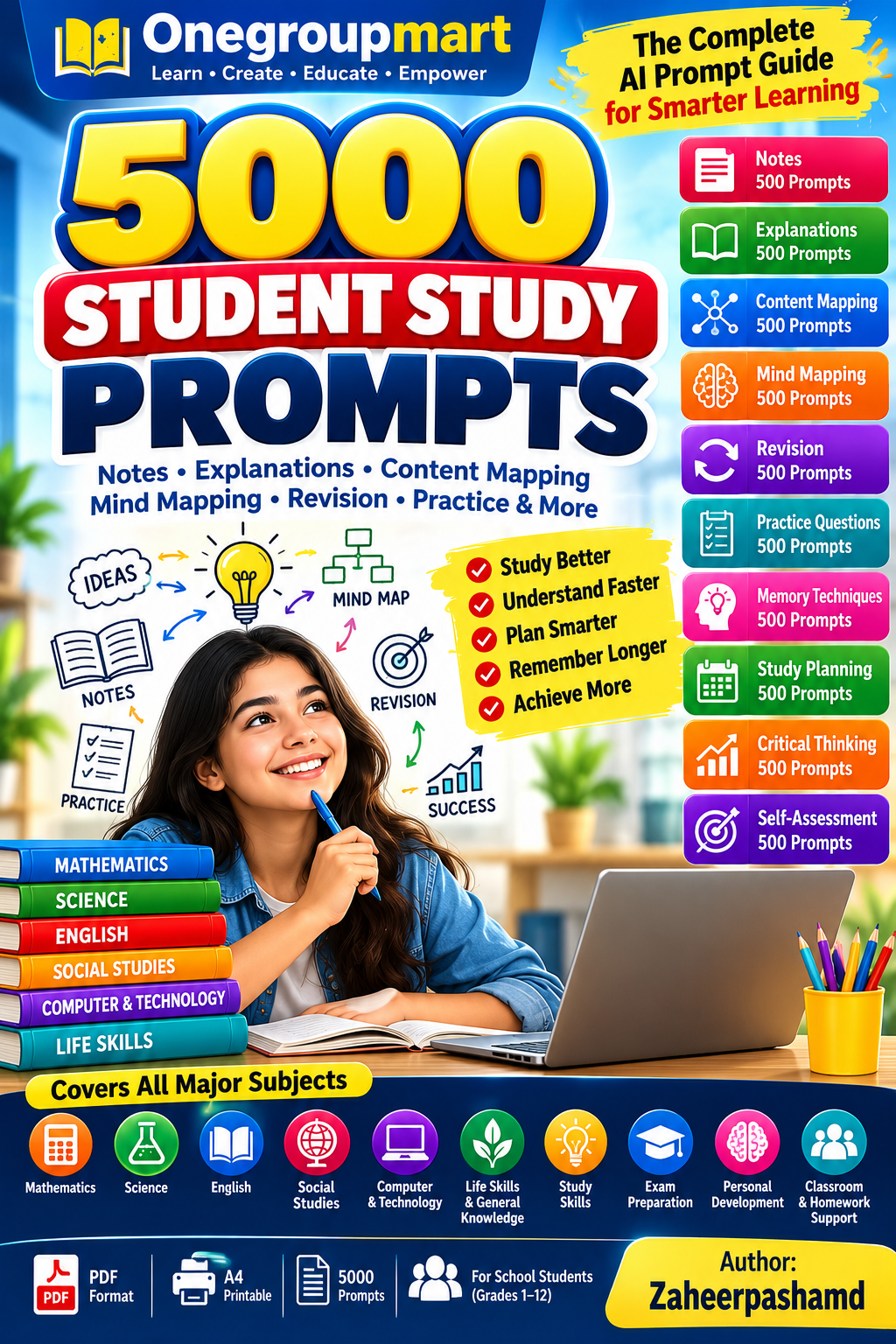
Study smarter with 5,000 AI prompts designed to help students create effective notes, understand difficult concepts, build content and mind maps, revise lessons, practise questions, improve memory, plan study schedules, develop critical thinking, and prepare for exams. Organised into 10 chapters with 500 prompts each, this practical digital eBook is ideal for students, teachers, tutors, parents, and self-learners who want to make learning more organised and productive.
Format: PDF Digital Download | Brand: Onegroupmart | Author: Zaheerpashamd
Description
5000 Student Study Prompts | The Complete AI Study Guide for Smarter Learning
Long Product Description
Study smarter, understand better, remember longer, and prepare for exams with the Onegroupmart 5000 Student Study Prompts eBook!
Are you a student who wants to create better notes, understand difficult lessons, organize study materials, remember important concepts, and prepare more effectively for examinations? The 5000 Student Study Prompts eBook is designed to help you use AI tools as a learning assistant for everyday study, revision, practice, and academic improvement.
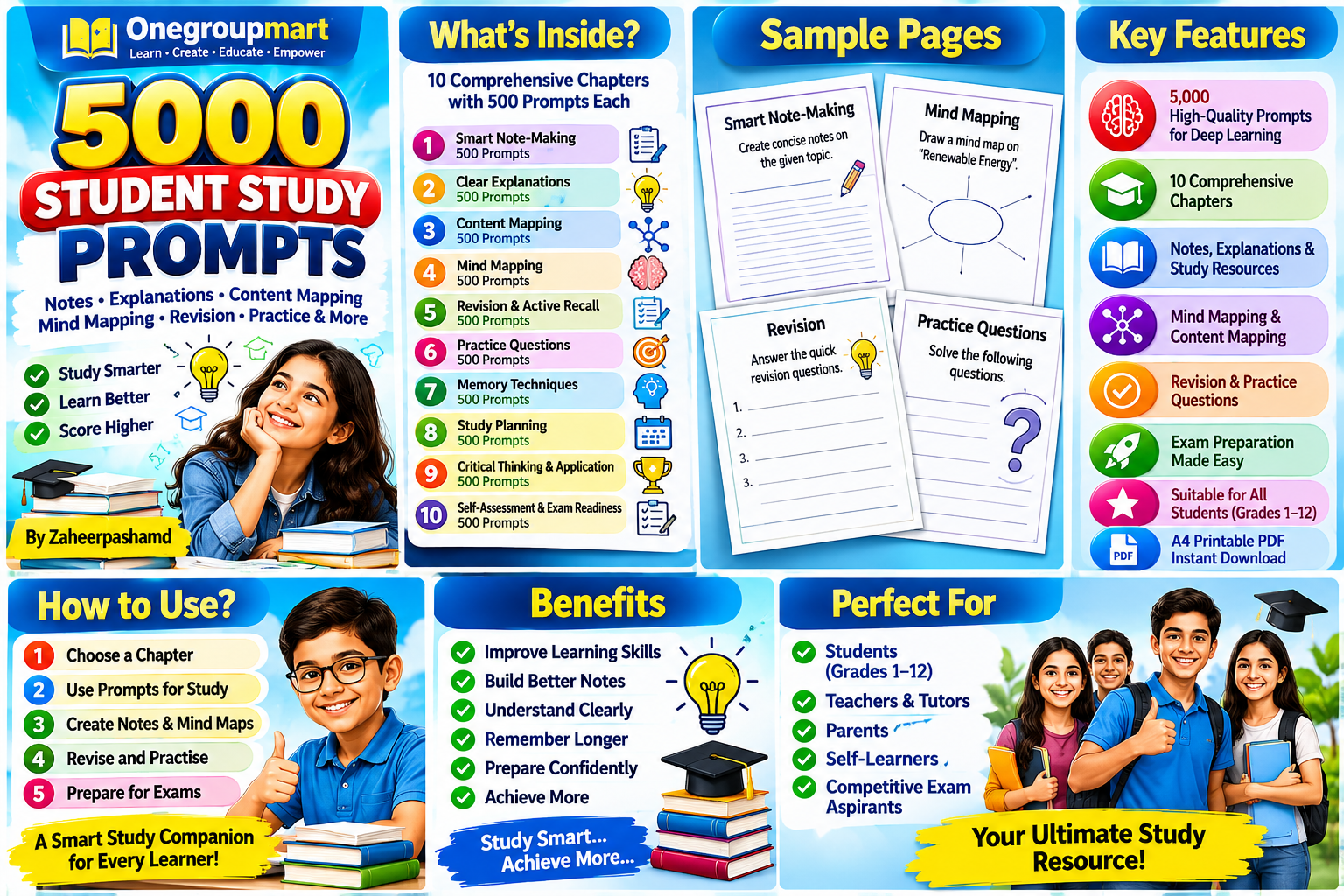
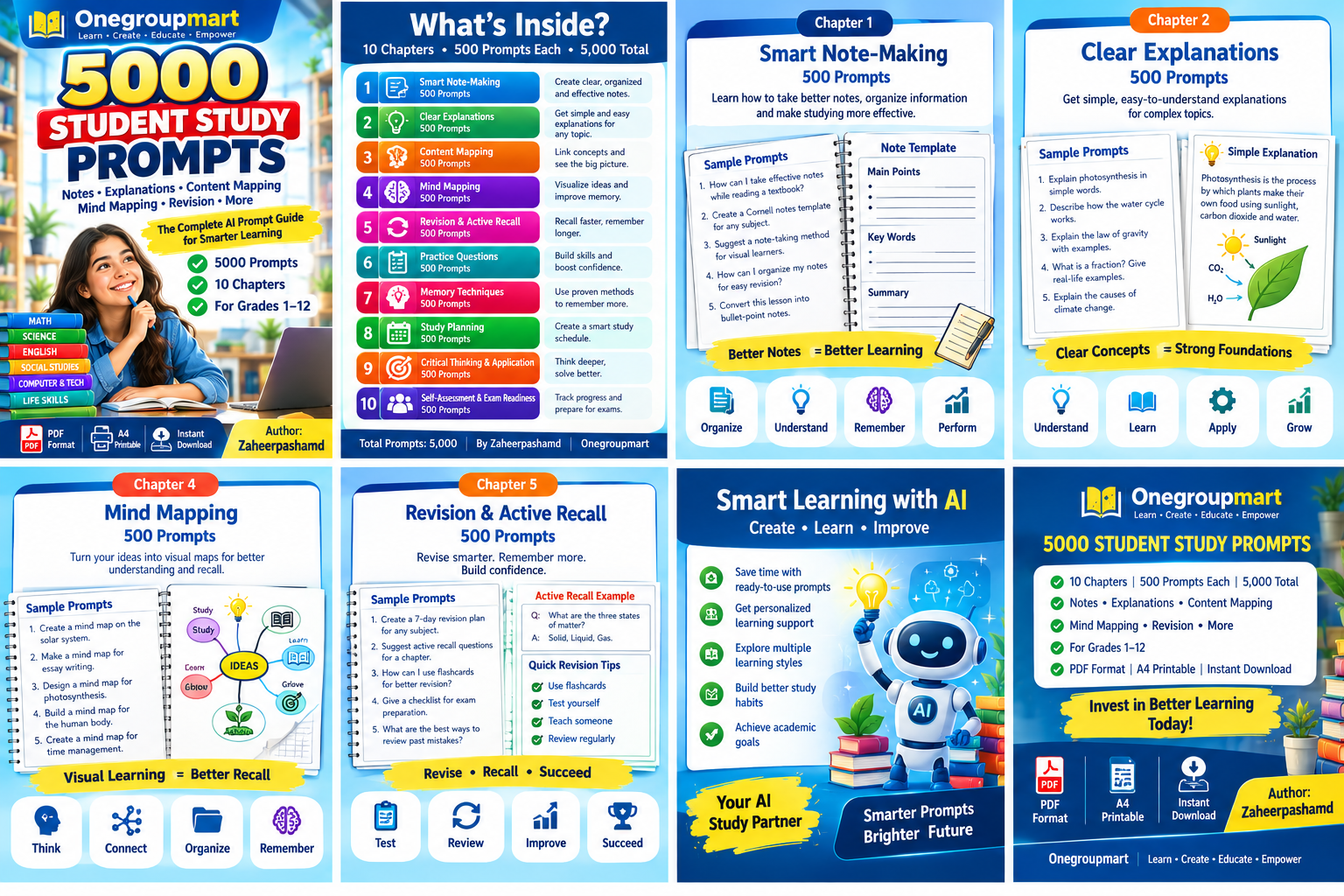
Published under the Onegroupmart brand and authored by Zaheerpashamd, this comprehensive digital resource brings together 5,000 AI prompts organised into 10 chapters, with 500 prompts in each chapter. The prompts cover essential study activities, from note-making and clear explanations to content mapping, mind mapping, revision, practice questions, memory techniques, study planning, critical thinking, and exam readiness.
Instead of struggling to decide what to ask an AI tool, you can use these ready-to-use prompts to guide your learning process, generate structured study materials, identify knowledge gaps, and practise explaining concepts in your own words.
Whether you are a school student, a college learner, a competitive-exam aspirant, a teacher, a tutor, or a lifelong learner, this eBook offers a practical collection of prompts to help you organise your learning more effectively.
What Makes This eBook Valuable?
Learning is not just about reading textbooks repeatedly. Students also need to understand concepts, connect ideas, practise retrieving information from memory, solve problems, and review what they have learned.
The Onegroupmart 5000 Student Study Prompts eBook provides prompts for these different learning activities. You can use them with compatible AI tools to turn lessons into structured notes, request step-by-step explanations, create revision questions, organise concepts visually, and plan study sessions around your available time.
With this eBook, you can explore ways to:
- Create clear and organised study notes.
- Understand complex topics through simpler explanations.
- Build content maps and structured chapter outlines.
- Create text-based mind maps and connect related concepts.
- Prepare flashcards and active-recall questions.
- Generate practice exercises and self-assessment tests.
- Develop useful memory techniques.
- Organise weekly study plans and revision schedules.
- Practise critical thinking and real-world applications.
- Identify weak areas and prepare more confidently for exams.
Explore the 10 Chapters
Chapter 1: Smart Note-Making – 500 Prompts
Good notes help students organise information, identify important points, and review lessons more efficiently.
This chapter contains prompts for creating concise notes, summarising textbook chapters, organising information under headings, extracting key terms, preparing revision sheets, and structuring rough notes into a clearer format.
Use these prompts to explore:
- Chapter summaries and concise study notes.
- Cornell-style notes and structured outlines.
- Key definitions, formulas, facts, and examples.
- Glossaries of important terminology.
- One-page revision sheets.
- Question-and-answer notes.
- Topic-wise study guides.
- Important points and common mistakes.
Chapter 2: Clear Explanations – 500 Prompts
Sometimes a textbook explanation is difficult to understand on the first reading. This chapter helps you formulate prompts that ask AI tools to explain concepts in simpler language and in a logical sequence.
You can request step-by-step explanations, everyday examples, analogies, worked examples, comparisons, and explanations of common misconceptions.
Use these prompts to:
- Understand difficult lessons.
- Break complex concepts into smaller parts.
- Learn unfamiliar terminology.
- Compare similar concepts.
- Explore practical applications.
- Request examples at different difficulty levels.
- Identify and correct misunderstandings.
- Explain concepts in your own words to check comprehension.
Chapter 3: Content Mapping – 500 Prompts
Content mapping helps you see how a chapter is organised and how its individual concepts fit together.
This chapter includes prompts for creating chapter maps, topic outlines, learning pathways, hierarchical structures, concept tables, and connections between related ideas.
You can use these prompts to:
- Organise chapters into main topics and subtopics.
- Identify prerequisite knowledge.
- Connect facts with supporting examples.
- Arrange concepts from basic to advanced.
- Compare related ideas.
- Map causes and effects.
- Organise events, dates, and important information where relevant.
- Prepare structured outlines before studying or writing answers.
Chapter 4: Mind Mapping – 500 Prompts
Mind maps provide a visual way to organise ideas around a central topic. They can help students recognise relationships between concepts and create memorable revision materials.
This chapter provides prompts for designing text-based mind maps and planning visual diagrams that you can draw or recreate using compatible mind-mapping software.
Explore prompts for:
- Topic-based mind maps.
- Chapter revision maps.
- Cause-and-effect diagrams.
- Concept connections and labelled branches.
- Process and sequence maps.
- Comparison mind maps.
- Keyword-based memory aids.
- One-page visual revision resources.
Chapter 5: Revision and Active Recall – 500 Prompts
Effective revision involves more than rereading the same material. Students can strengthen learning by trying to recall information, answering questions without looking at notes, and revisiting important topics over time.
This chapter contains prompts for active recall, flashcards, self-quizzing, spaced-repetition schedules, blank-page recall, and short revision sessions.
Use these prompts to:
- Prepare quick revision plans.
- Create flashcards.
- Test your understanding without notes.
- Generate short quizzes.
- Identify forgotten information.
- Build revision schedules.
- Review weak areas.
- Prepare concise last-minute revision sheets.
Chapter 6: Practice Questions – 500 Prompts
Practice questions help students apply their knowledge and identify concepts that need further attention.
This chapter includes prompts for generating different types of questions, including multiple-choice questions, short answers, long answers, fill-in-the-blanks, true-or-false statements, application-based problems, and mock tests.
Use these prompts to:
- Practise a lesson after studying it.
- Generate questions at different difficulty levels.
- Request answer keys and explanations.
- Prepare timed practice tests.
- Practise application-based questions.
- Review mistakes and misunderstandings.
- Create worksheets for self-study.
- Improve your ability to explain and apply concepts.
Chapter 7: Memory Techniques – 500 Prompts
Remembering facts, definitions, formulas, sequences, and terminology can be challenging. This chapter focuses on prompts that help you explore different memory strategies.
You can request mnemonics, acronyms, associations, visual cues, memory stories, chunking techniques, and retrieval-practice routines.
These prompts can help you:
- Remember lists and sequences.
- Group information into manageable chunks.
- Create associations between ideas.
- Develop memory aids for difficult terminology.
- Practise recalling important facts.
- Build personalised revision techniques.
- Identify information that needs more practice.
- Combine memory aids with regular revision.
Chapter 8: Study Planning – 500 Prompts
A realistic study plan can help you manage time, divide large chapters into smaller tasks, and balance learning with revision and practice.
This chapter contains prompts for daily schedules, weekly plans, study checklists, progress trackers, focused study sessions, and catch-up plans.
Use these prompts to:
- Build a weekly study timetable.
- Break a large syllabus into manageable milestones.
- Prioritise challenging subjects.
- Organise focused study sessions.
- Track progress and confidence.
- Plan revision before examinations.
- Adjust your schedule when you fall behind.
- Balance note-making, practice, and recall.
Chapter 9: Critical Thinking and Application – 500 Prompts
Understanding a subject also means being able to analyse information, compare ideas, evaluate evidence, and apply knowledge to unfamiliar situations.
This chapter includes prompts designed to support deeper thinking and practical problem-solving.
Explore prompts for:
- Real-world applications of academic concepts.
- Cause-and-effect analysis.
- Comparing different approaches.
- Distinguishing facts from opinions and inferences.
- Evaluating evidence and assumptions.
- Solving scenario-based problems.
- Connecting knowledge across subjects.
- Developing analytical and higher-order questions.
Chapter 10: Self-Assessment and Exam Readiness – 500 Prompts
Preparing for an examination involves understanding the material, practising relevant questions, identifying weak areas, and reviewing answers carefully.
This chapter includes prompts for self-assessment, exam-style questions, answer improvement, reflection, and final revision planning.
Use these prompts to:
- Assess your understanding of a topic.
- Identify gaps in your knowledge.
- Practise exam-style questions.
- Improve the structure of written answers.
- Review mistakes and learn from them.
- Prepare answer-checking lists.
- Create final revision checklists.
- Set practical goals for your next study session.
Who Is This eBook For?
School Students: Use prompts to supplement classroom learning, organise notes, understand lessons, and prepare for tests.
College and University Students: Explore structured note-making, concept mapping, research planning, revision, and analytical thinking.
Competitive-Exam Aspirants: Generate practice questions, organise revision, test recall, and structure preparation sessions around the syllabus you provide.
Teachers and Tutors: Use the prompts as starting points for preparing explanations, study guides, revision questions, and supplementary learning materials.
Parents Supporting Learning at Home: Help students organise their study routines and explore alternative explanations for difficult topics.
Self-Learners: Use AI prompts to organise independent learning, break unfamiliar subjects into smaller topics, and monitor progress.
The eBook is intended as a supplementary study resource. Individual prompts should be adapted to the learner’s age, subject, educational level, curriculum, and learning goals.
How to Use the 5000 Student Study Prompts
Using the eBook is straightforward.
- Choose a study goal. Decide whether you need notes, an explanation, a mind map, practice questions, or a revision plan.
- Select a relevant prompt. Find a prompt in the corresponding chapter.
- Personalise the prompt. Replace the sample topic with your actual subject, chapter, or lesson.
- Add useful context. Include your grade level, syllabus, learning objectives, or textbook notes where appropriate.
- Review the result. Check important information against reliable textbooks, class notes, and teacher guidance.
- Practise actively. Answer questions, explain ideas in your own words, and test your understanding without relying entirely on AI-generated notes.
- Review and improve. Use the results to identify gaps and decide what to study next.
Example of a Customised Study Prompt
“I am a Grade 8 student studying photosynthesis. Explain the concept in simple language, organise the explanation under clear headings, list the important scientific terms, provide a practical example, create a text-based mind map, and finish with five revision questions. Use accurate science terminology and point out anything that needs verification.”
You can adapt the same approach to mathematics, science, English, social studies, computer studies, and other subjects.
Benefits of Using AI Study Prompts
- Better organisation: Structure information into notes, outlines, and topic maps.
- Clearer understanding: Request alternative explanations when a concept is difficult.
- More active revision: Practise recall through questions, quizzes, and flashcards.
- Flexible learning: Adapt prompts to different subjects and learning goals.
- Targeted practice: Focus on the topics you find challenging.
- Improved study planning: Divide learning tasks into manageable sessions.
- Deeper thinking: Explore applications, comparisons, and analytical questions.
- Greater independence: Use prompts to guide your own learning and reflection.
These benefits depend on how you use the prompts, the quality of the source material you provide, and the accuracy of the AI tool’s responses. The prompts support learning; they do not guarantee particular grades or examination results.
Digital Product Details
- Product title: 5000 Student Study Prompts
- Brand: Onegroupmart
- Author/Publisher name: Zaheerpashamd
- Product type: Educational eBook and AI prompt library
- Format: PDF digital download
- Total prompts: 5,000
- Organisation: 10 chapters, 500 prompts per chapter
- Main topics: Notes, explanations, content mapping, mind mapping, revision, practice questions, memory techniques, study planning, critical thinking, and exam readiness
- Intended audience: Students, teachers, tutors, parents, and self-learners
- Delivery: Digital download; no physical product will be shipped
Important Information About AI Use
AI tools may sometimes provide incorrect, incomplete, or outdated information. Always verify important facts, formulas, dates, quotations, calculations, and subject-specific explanations using reliable sources.
Follow your school’s or institution’s rules regarding AI-assisted work. Use the prompts to understand concepts and improve your own skills rather than submitting generated work as your own when that is not permitted. Avoid sharing personal information, passwords, private student records, or confidential school documents with AI tools.
The prompts are general-purpose study aids. They do not guarantee alignment with every school board, textbook, syllabus, or examination pattern. Provide your syllabus or relevant lesson material when you need more targeted assistance.
Start Building Smarter Study Habits
The Onegroupmart 5000 Student Study Prompts eBook gives you a structured library of prompts for organising study notes, understanding lessons, mapping concepts, practising recall, improving problem-solving, and preparing for examinations.
With 10 chapters and 5,000 prompts, you can choose a study activity that matches your current learning goal and adapt it to your own subjects and academic level.
Whether you are reviewing a difficult chapter, preparing for an upcoming test, creating a revision timetable, or exploring a new topic, this eBook can help you make more purposeful use of AI-assisted learning.
Study smart. Understand deeply. Practise consistently. Keep learning.
Onegroupmart — Learn • Create • Educate • Empower
Author: Zaheerpashamd
Related products
-
Sale!
Child Coloring Book and Medindi Desings
Original price was: ₹199.00.₹79.00Current price is: ₹79.00. Add to cart -
Sale!
AI Character Creation Bundle – 10,000 Creative AI Prompts for Fantasy, Superheroes, Mythology, Sci-Fi & More
Original price was: ₹899.00.₹299.00Current price is: ₹299.00. Add to cart -
Sale!
Mehendi Designs eBook – Beautiful Traditional and Modern Henna Patterns
Original price was: ₹99.00.₹39.00Current price is: ₹39.00. Add to cart -
Sale!
COLOR ME – Kids Coloring Book
Original price was: ₹199.00.₹59.00Current price is: ₹59.00. Add to cart
Reviews
There are no reviews yet.